Connect this guide with the rest of your visit in the Milan trip planner. Read how the research is made and what its sources establish.
At a glance
Start here
- Use Sant’Ambrogio to read early Christian memory through Romanesque form.
- Use Sant’Eustorgio for archaeology, convent spaces, and the Portinari Chapel.
- Check liturgical and museum schedules separately.
- Keep conversation, photography, and movement appropriate to active worship.
01
Why these two churches belong together
Both complexes carry early Christian memory, yet they tell it through different surviving structures. Sant’Ambrogio’s official history begins with the basilica founded under Ambrose from 379 and follows rebuilding, decoration, damage, and restoration. Sant’Eustorgio’s museum places archaeology below ground and later convent and chapel spaces above it.
The pairing is useful because it resists the idea that a historic church has one date. Foundations, burials, medieval rebuilding, Renaissance patronage, and modern restoration overlap. Look for where one period preserves, covers, or interprets another. That habit makes the buildings easier to understand than a list of saints and dates.
- Read each complex as a sequence of building campaigns.
- Separate church access from museum access.
- Give each site a distinct question rather than comparing size.
02
Begin Sant’Ambrogio with Ambrose and the martyrs
The basilica’s history identifies construction beginning in 379 under Bishop Ambrose, in an area associated with Christian burials. The story of the martyrs Gervasius and Protasius and Ambrose’s own burial established the site as a powerful place of memory. This late-antique origin matters even though much of the visible architectural character is later.
Enter with that distinction in mind: historical foundation is not the same as an untouched fourth-century building. The complex records repeated acts of commemoration and rebuilding. Before concentrating on individual objects, use the nave, altar area, and relationship between spaces to ask how later communities gave architectural form to an older sacred history.
- Distinguish the fourth-century foundation from later fabric.
- Notice how burial memory shapes the church’s identity.
- Read official labels before attaching a date to a visible element.
03
Use the atrium and brickwork to read Romanesque space
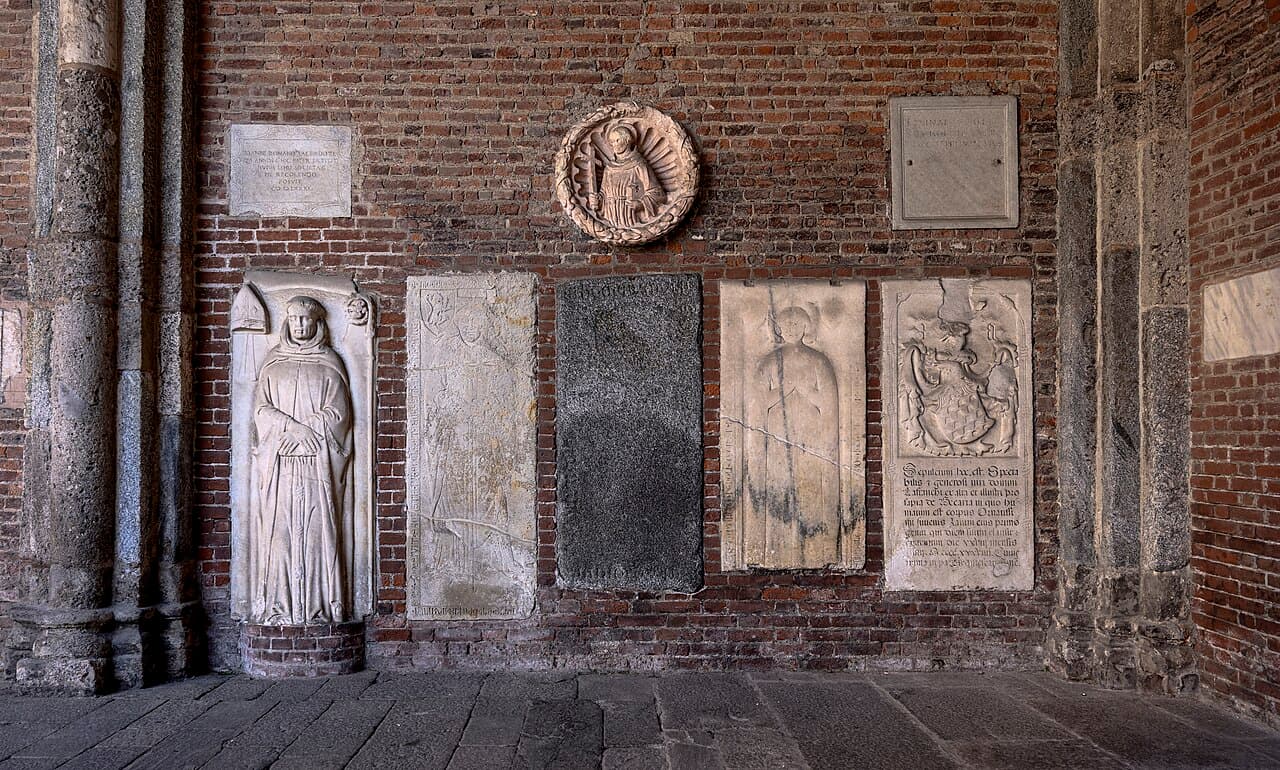
Sant’Ambrogio’s monumental-complex guide describes a red-brick basilica with a broad atrium and two bell towers. Its history places the major Romanesque rebuilding between the late eleventh and early twelfth centuries. The atrium delays the entry, creating a transition between city and church before the interior’s measured bays take over.
Look at mass, rhythm, and thresholds rather than searching only for decoration. The two towers are not twins produced in one campaign, and the complex’s asymmetry is part of its long life. The basilica became an important model precisely because structure and spatial sequence carry meaning alongside the precious altar and devotional furnishings.
- Pause in the atrium before entering the nave.
- Compare the two bell towers rather than assuming symmetry.
- Read brick, vaulting, and bay rhythm as part of the monument.
04
At Sant’Eustorgio, follow the museum route downward and upward
The Museo di Sant’Eustorgio describes a route beginning with an early Christian burial ground and continuing through the chapter house, monumental sacristy, and Portinari Chapel. The regional museum record confirms that the complex combines Dominican convent spaces, below-ground archaeology, and Renaissance art. It is therefore a layered museum rather than a single chapel visit.
Start with the archaeological level if available, because it establishes the ground on which later buildings acquired meaning. Then read the chapter house and sacristy as communal and institutional spaces before entering the chapel. This sequence makes the Renaissance commission feel like one chapter in a much longer religious site, not an isolated masterpiece.
- Check which parts of the museum route are open.
- Use archaeology to establish the earliest layer.
- Notice how convent functions differ from chapel patronage.
05
Give the Portinari Chapel time to become legible
The museum and basilica sources date the Portinari Chapel’s construction to the 1460s, with completion in 1468. The chapel is associated with Pigello Portinari and with frescoes by Vincenzo Foppa; it also contains the ark of Saint Peter Martyr by Giovanni di Balduccio. Architecture, painting, sculpture, and patronage work together in one concentrated space.
Do not reduce it to a quick photograph of the dome. Follow the painted architecture, figures, windows, and tomb in relation to one another. Ask how the chapel distinguishes itself from the older basilica while remaining attached to it. The contrast is the point: a Renaissance visual language enters a site with much deeper Christian and Dominican histories.
- Circle the space slowly if visitor flow permits.
- Relate Foppa’s frescoes to the chapel’s real architecture.
- Include the sculpted ark in the reading, not only the dome.
06
Plan around worship, not across it
Sant’Ambrogio publishes separate basilica and schedule pages. Sant’Eustorgio separates the basilica from a ticketed museum route, but its published admissions page retains dated operating instructions; use its contact details to confirm current arrangements. Those distinctions should shape behavior and timing. Sightseeing access may pause for worship, while a museum ticket does not turn the adjoining church into an ordinary gallery.
Before leaving, confirm liturgies, museum opening, last admission, temporary closures, and any photography rules. Inside, silence devices, avoid crossing active services, and follow staff directions. Clothing and conduct should suit a functioning church. If access changes, use the exterior and official historical material rather than treating a religious service as an obstacle.
- Check the basilica and museum schedules independently.
- Do not enter a chapel or cross the nave during a service without direction.
- Ask before using tripods, flash, or other intrusive equipment.
Useful answers
Reader questions
Is Sant’Ambrogio still a working church?
Yes. The basilica publishes liturgical and visitor information separately, so sightseeing should be planned around worship and current access. Check its official schedule shortly before going.
Sources: Basilica di Sant’Ambrogio; Basilica di Sant’AmbrogioWhat does the Museo di Sant’Eustorgio include?
Its route includes an early Christian burial area, the chapter house, monumental sacristy, and Portinari Chapel. Availability can change, so verify the current museum route and admission page.
Sources: Museo di Sant’Eustorgio; Regione Lombardia; Museo di Sant’EustorgioWho painted the Portinari Chapel frescoes?
The official chapel and museum sources identify Vincenzo Foppa with the fresco cycle. The chapel also contains the ark of Saint Peter Martyr by Giovanni di Balduccio.
Sources: Basilica di Sant’Eustorgio; Regione LombardiaCan I use fixed opening hours from this guide?
No. Church services, museum operations, and temporary restrictions can change. Use Sant’Ambrogio’s official schedule, and confirm Sant’Eustorgio’s current arrangements directly through the contact details on its published admission page.
Sources: Basilica di Sant’Ambrogio; Museo di Sant’EustorgioRead the evidence
Sources and further reading
These sources support the relevant sections above. Plans and comparisons are editorial suggestions. Check operators for current arrangements.
- History ↗Basilica di Sant’Ambrogio · Research date 14 September 2026
Foundation under Ambrose, martyr and burial history, Romanesque rebuilding, later interventions, wartime damage, and restoration.
- The Basilica ↗Basilica di Sant’Ambrogio · Research date 14 September 2026
Religious identity, visitor framing, basilica access context, and official sightseeing information.
- Monumental complex ↗Basilica di Sant’Ambrogio · Research date 14 September 2026
Architectural plan, red brick, atrium, bell towers, and Romanesque character.
- Schedules ↗Basilica di Sant’Ambrogio · Research date 14 September 2026
Official live schedule and distinction between worship and sightseeing times.
- The museum ↗Museo di Sant’Eustorgio · Research date 14 September 2026
Museum sequence through burial ground, chapter house, sacristy, and Portinari Chapel.
- Opening hours and admissions ↗Museo di Sant’Eustorgio · Research date 14 September 2026
Published hours, admission information, and museum contact details; the page retains dated pandemic-era instructions, so current operations require direct confirmation.
- Museo di Sant’Eustorgio Milano ↗Regione Lombardia · Research date 14 September 2026
Recognized-museum description of archaeology, Dominican convent spaces, Portinari Chapel, Foppa frescoes, and the sculpted ark.
- Portinari Chapel ↗Basilica di Sant’Eustorgio · Research date 14 September 2026
Commission, 1460s construction, 1468 completion, and attribution of the frescoes to Vincenzo Foppa.